
On-Premise Tokenization Platform: Buy the Operating Layer
Why operators choose an on-premise tokenization platform over building from scratch: issuance, onboarding, registry, controlled secondary and audit logs.
By Dimitri RossPublished Updated 8 min read
On this page (12)
An on-premise tokenization platform is tokenization software deployed in an environment the operator controls, such as its own cloud account, private cloud or bank perimeter, instead of a vendor's shared SaaS. Regulated institutions choose it for data residency, inspection by regulators and partner banks, and continuity of the ownership record. Asset Haus delivers it as a client-controlled tokenization platform deployment with source-code handover; the hosted alternative is covered in the white-label tokenization platform guide.
A private-market operator came to us after spending roughly $220,000 trying to build its own tokenization platform.
They had screens, code, a token concept and integrations in progress. What they did not have was a platform they could confidently launch.
The issue was sequencing. They built features before the legal record, KYC gate, document access, registry, transfer perimeter, audit exports, licensing evidence and continuity plan were clear.
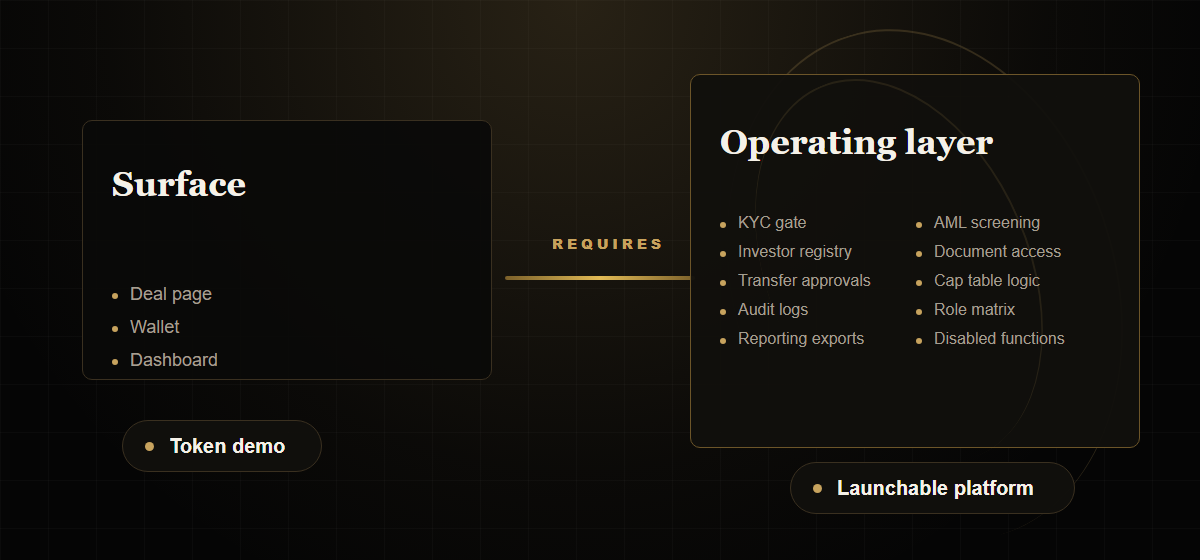
Tokenization looks like a deal page, a wallet and a token. The real product is the operating layer behind it.
The mistake: treating tokenization as a normal software build
Most failed tokenization builds start with the same assumption:
“We can build this ourselves.”
That may be true for a proof of concept. It is rarely the fastest path for a licensing-ready private-market platform.
A real platform coordinates issuance, onboarding, KYC, data rooms, registry, reporting, controlled transfers, audit logs, deployment controls and secondary-market logic. That is not a normal web app. It is financial operating infrastructure.
In this article, “on-premise” means client-controlled deployment. The platform can run inside the client’s cloud account, private cloud, bank perimeter, regulated partner infrastructure or a hybrid setup where sensitive modules stay inside the client environment.
The point is not physical server location. The point is control: the operator can inspect, evidence and govern how the system works.
The better question: what should you own?
The question is not only “should we build or buy?” The better question is: which parts of the system should we own, and which parts should we start from a tested base?
A serious operator should own the brand, client relationship, regulated perimeter, access decisions, policies, data, deployment environment and commercial model. That does not mean rebuilding portals, KYC workflows, staged disclosure, registry, reporting, audit logs, controlled transfers and optional secondary modules from zero.
Asset Haus describes these platform and workflow components across Solutions and in the Platform Overview PDF. To weigh the four launch routes side by side (one deal through a private listing, a branded hosted platform, a client-controlled deployment or a custom build), use the build, buy or list decision guide.
Why a $40k–$60k platform license changes the decision
Asset Haus platform license pricing typically starts at $40,000–$60,000, depending on modules and scope.
That does not mean a full regulated business launches for $60k. Implementation, custom work, external counsel, licensing fees, audits, custody, localization and third-party providers are separate.
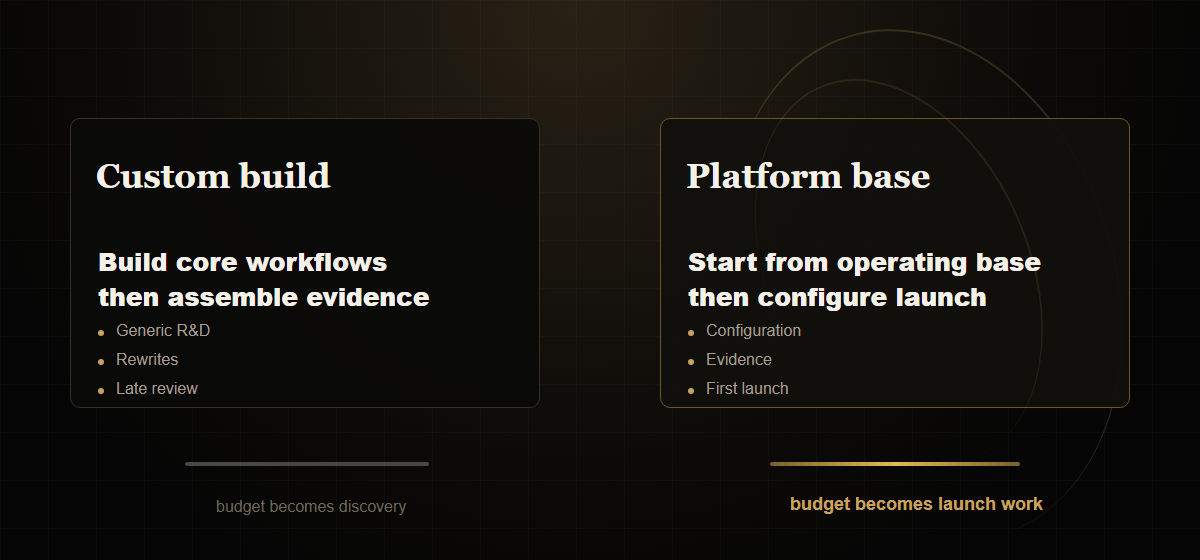
But the license changes the economics of the first six months. Instead of funding basic platform R&D, the operator starts from a working base and spends time on structure, eligibility, partner onboarding, first issuance and repeat-deal operations.
A $40k–$60k platform license is not a shortcut around regulation. It is a way to start from a tested operating base before the licensing perimeter is final.
What usually breaks when teams build first
The failure modes are predictable. The token is built before the registry, so balances and legal ownership can diverge. KYC is added too late, so eligibility does not control document access, subscriptions or transfers. The data room stores files but does not show investor intent. Secondary-market features are built before the perimeter is approved.
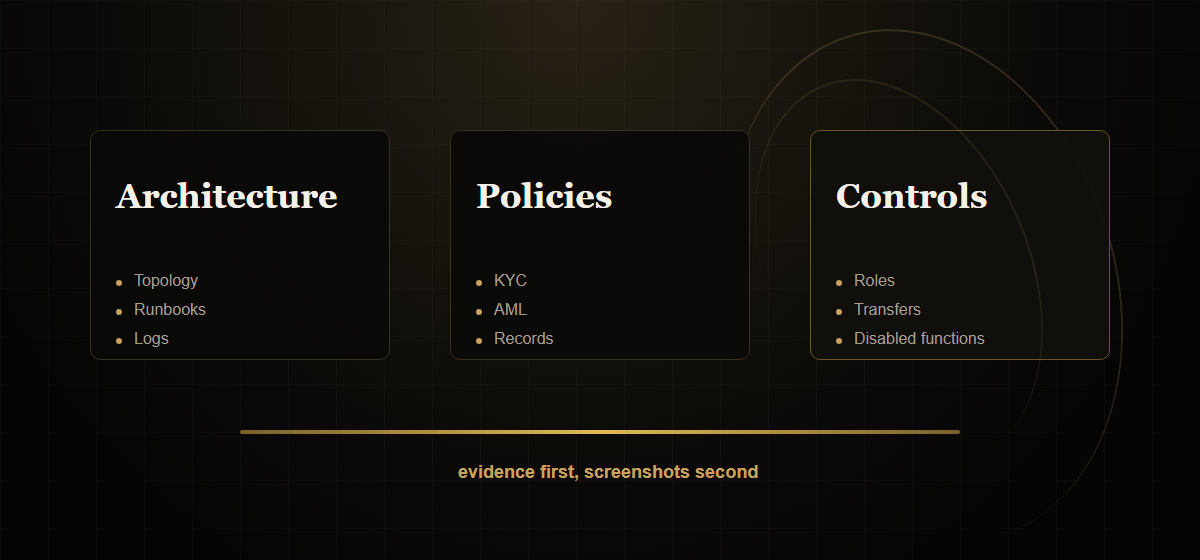
The most expensive mistake is evidence coming after the build. A licensing-ready operator needs architecture, deployment topology, role matrices, audit exports, KYC and AML integration maps, custody responsibilities, transfer controls, continuity procedures and a disabled-functions register. Trying to assemble that after the platform is already built is slow and expensive.
What Asset Haus provides
Asset Haus is a white-label, on-premise and private-cloud platform for private-market issuance, investor operations and controlled secondary workflows.
Read the platform by operating layer:
| Layer | What it covers |
|---|---|
| Core operations | Issuer and investor portals, KYC and AML, staged disclosure, registry, reporting and audit logs. |
| Control | Client-controlled deployment, white-label branding, source-code access options, APIs, roles and runbook support. |
| Secondary | Restricted transfers, transfer-agent approval, RFQ, bulletin-board and OTC workflows, plus optional professional CLOB where the perimeter allows. |
The buyer is not only buying token issuance. They are buying a controllable environment, evidence for counsel and regulated partners, continuity if a vendor relationship changes and secondary functions that can remain disabled until permitted.
Source-code delivery: what "on-premise" should actually include
For regulated operators, on-premise deployment without source-code delivery is half a solution. Source-code access is what turns a vendor relationship into owned infrastructure:
- Continuity. If the vendor relationship ends — commercially or because the vendor disappears — the platform, registry, and compliance logic keep running. The authoritative ownership record is never hostage to a third party's uptime.
- Regulator and counsel inspection. Licensing processes and bank-partner diligence increasingly ask how the system works, not just what it does. Inspectable code plus deployment topology is evidence; a SaaS API is a promise.
- Data residency. Investor records, KYC files, and the registry stay in-region, inside the operator's perimeter — a hard requirement for many banks and for several GCC and EU deployments.
- Custom perimeter control. Disabled-functions registers, jurisdiction-specific transfer rules, and integrations with local custodians or banks can be implemented without waiting on a vendor roadmap.
Source-code access options range from escrow (release on defined trigger events) to full delivery with a license perimeter. The right model depends on the operator's licensing route and internal engineering capacity — the trade-offs are part of any deployment-model decision.
What should stay disabled until approved
A serious platform should not enable everything by default.
Sensitive functions should usually remain disabled until counsel and the licensed partner confirm the perimeter: public marketplace access, automatic matching, CLOB, open transfers, retail access, public solicitation, unlicensed custody or settlement logic and investor-facing “buy now” flows.
That is not a limitation. It is deployment discipline.
Implementation path
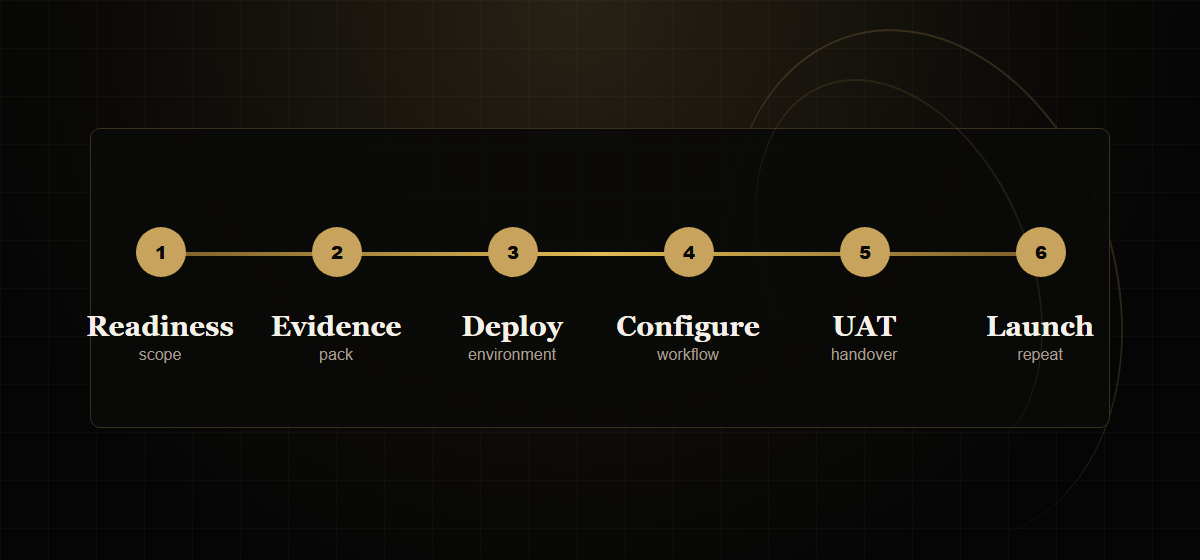
Some clients should first test investor interest through a closed discovery layer. Others can move directly into readiness mapping, evidence pack, deployment, configuration, UAT and first product launch.
The goal is not just launch. The goal is to create a reusable operating base for the next product.
Asset Haus is a fit when the operator is launching repeated private-market products, working toward DASP, ADGM, VASP, CASP or similar licensing routes, partnering with a licensed perimeter, or planning RFQ, OTC or CLOB-ready infrastructure.
It is probably not a fit if you only need a one-off token landing page.
FAQ
What is source-code delivery in tokenization?
Source-code delivery means the operator receives the platform's code as part of the engagement — deployable in their own cloud account, private cloud, or bank perimeter. It removes vendor lock-in: the registry and compliance workflows continue operating even if the vendor relationship changes.
Is on-premise the same as running my own servers?
No. "On-premise" here means client-controlled deployment: the operator's cloud account, private cloud, regulated-partner infrastructure, or hybrid setups where sensitive modules stay inside the client environment. The point is control and evidence, not physical hardware.
Why do regulated institutions require on-premise tokenization?
Three reasons recur: data residency (investor and registry data must stay in-region), inspection (regulators and partner banks want to evidence how the system works), and continuity (the authoritative ownership record cannot depend on a third-party SaaS surviving).
Can secondary trading features ship disabled?
Yes — and they should. Matching, CLOB, open transfers, and retail access should remain disabled until counsel and the licensed partner confirm the perimeter. A disabled-functions register is part of the licensing evidence pack.
Final thought
A tokenization platform is not valuable because it can mint a token.
It is valuable when it helps an operator control deployment, data, access, transfer logic, audit evidence, enabled functions and the path from the first product to repeatable operations.
For serious private-market operators, control is not a premium feature. Control is the foundation.
Plan a controlled launch
Planning to launch a tokenized private-market platform, DASP, ADGM or similar route, controlled secondary workflow or CLOB-ready operating model?
Asset Haus can provide the on-premise and private-cloud platform, source-code access options, licensing-readiness evidence pack, controlled secondary modules and structuring workflow.
Disclosure
This article is not legal, tax, regulatory or investment advice. Licensing requirements differ by jurisdiction and activity. Asset Haus provides technology infrastructure, structuring coordination and workflow tooling; it does not provide broker-dealer, exchange, custody, legal, tax or investment advisory services.
About the author

CTO
5+ years in tokenization and blockchain infrastructure; previously led engineering at a DeFi protocol.
Profile and articles: Dimitri RossLinkedIn: Dimitri Ross (opens in a new tab)
Tags
- on-premise
- tokenization-platform
- digital-assets
- build-vs-buy
- licensing-readiness
- controlled-secondary
Related Articles
Platform & Infrastructure
White-Label Tokenization Platform: Providers Compared
What a white-label tokenization platform is, how it is priced, and how Brickken, ChainUp, Tokeny and Asset Haus compare on hosting, code and pricing.
Updated 18 min read
Platform & Infrastructure
Bank Tokenization Platform Requirements Checklist
A bank tokenization platform requirements checklist for control, integration, custody, compliance, reconciliation, and phased delivery.
Updated 14 min read
Platform & Infrastructure
The Registry of Record for Tokenized Securities
The registry of record for tokenized securities: on-chain, off-chain, and hybrid register models, divergence rules, and operational requirements.
11 min read